“I have taken out my invisalign… and…this is the album!!!!!!”
This is how Billie Eilish’s album, ‘When We All Fall Asleep, Where Do We Go?’ opens. It caught me completely off guard. I was expecting a cheesy shout out to fans, an explanation of what was to follow, something ‘inspirational’ written by Eilish’s creative team to introduce her to the world.
Instead, I got Eilish taking out her braces (invisalign), stuttering, and bursting into laughter with brother Finneas O’Connell. What follows is by no means a perfect album, but something far more exciting: a pop album that is fresh, innovative and, most importantly, completely Eilish’s creation.
I have long been obsessed with pop culture. I once stopped to evaluate this obsession when my friend said, in response to a comment I made about a pop star, ‘I don’t really care about celebrities’. The notion of not caring about what is going on in pop music is alien to me. For as long as I can remember, I have turned to music and celebrity as a consolation, as a way of blocking out my thoughts and escaping to a world that seemed altogether better and more exciting than the daily humdrum of life.
My obsession reached a peak when I was around 15 and bought the book ‘Britney Spears: Inside the Dream’ by Steve Dennis. I devoured it, and proceeded to watch every interview and documentary I could find on Youtube about Spears. More than her music, I was entranced by the rise and fall of a global superstar. I fixated on the change in Spears from her prime to her later career (2008 onwards), reading the biography to try and understand why a woman who seemingly had it all – fame, money, power, looks, talent – had shaved her head and given a giant ‘fuck you’ to the world.
The book contained passages that psychoanalysed Spears, detailing the potential catalysts of her breakdown. It was, above all, a speculation; the events commented on happened, but the reasonings in the biography are just ideas bounced around and presented as fact. Spears had no part in this book, and has yet to release an autobiography of her own.
The closest we have to that is her documentary ‘For The Record’, released in 2008, which sees Spears flitting from upbeat to tearful over the lack of control she has in her life. Shortly after, her interviews became heavily scripted and her eyes became dead, most likely due to medication.
Another documentary, ‘Stages’, released in 2002, hinted at a darkness frothing beneath the gleaming surface long before her 2007 breakdown. Surprisingly candid and free of glamour or excess, the hour-and-a-half long documentary is a rare insight to Spears’s life at the time. It shows her wrapping up a long tour run in Mexico. Little to no time is devoted to actually showing Spears performing. Instead, we see her waking up, putting on makeup, going from one venue to another, eating, and napping, constantly surrounded by a large team of managers, helpers and dancers.
The documentary sits at odds with the mega glossy, high octane performances and videos Spears was releasing at the time: choreographed, pristine pop that was, above all, made to portray Spears as a godly sex vixen as well as the girl next door. At the time, she was the star that elicited audience shrieks and paparazzi hysteria.
What stuck out to me about this documentary is how sad Spears looks throughout the whole thing. Its telling that she looks her most carefree and happy when, at one point, she climbs out onto a window ledge for a photoshoot, laughing and waving at people staying in the same hotel who wave back in disbelief at the spectacle. The documentary is a jarring exposé of the reality of pop superstardom; a lonely, terrifying existence ruled by other people and gruelling tour schedules.
When Spears shaved her head in 2007 and attacked a paparazzi’s car with an umbrella, the lid was lifted on the darkness behind pop music. This is what happens when the machine becomes bigger than the person, eclipsing their sense of self and depriving them of their status as a ‘real’ person with human emotions.
You can see why, then, Billie Eilish is making waves. The intro to the album solidifies her status as something different to what has come before, something more human. Her career is, first and foremost, her own.
Katy Perry promised ‘pop with a purpose’ in 2017 with her album ‘Witness’. This album failed to deliver, churning out a half-hearted attempt at political statements and largely similar content to her previous releases. Witness was, sadly, not the ‘woke’ pop that people were waiting for.
‘When We All Fall Asleep’ is that album. The most exciting thing about it is that darkness is finally being explored in pop music. Depression, melancholia and self-doubt have long been the territory of alternative and indie artists, but rarely do these subjects get air time in mainstream pop. When negative or difficult emotions are expressed in pop music, there is usually a saccharine gloss applied, a positive spin that affirms the notion that pop’s purpose is to please, to uplift and to make people feel good.
Taylor Swift, Katy Perry, Lady Gaga, Ariana Grande… these were the mega stars of pop music as it was. They sang about love and heartbreak, overcoming trials, personal salvation, being a fighter, ignoring haters, and being your own boss, upholding the premise that life is, at its core, good, if you work hard. Take ‘Roar’ by Katy Perry: ‘You held me down, but I got up, Already brushing off the dust…I got the eye of the tiger, a fighter’.
How relevant are these messages in 2019? Songs like ‘Roar’ seem out of touch in today’s political climate; the girl-power lyrics of yesteryear fall flat in a post #MeToo and Trump era. The sugar sweet, capitalist-backing lyrics of working hard and believing in yourself seem obscene in a world where the foundations of life are shifting.
The first song I listened to from Billie Eilish was ‘bury a friend’. With lyrics like ‘I want to end me’ chanted against a backdrop of building squeaks and thumping drums, I knew I was in for a different pop experience. This was no ‘Roar’. The themes of death, alienation and fear permeate the whole album, with Eilish contemplating ‘Tell me which one is worse/Living or dying first’ in ‘You should see me in a crown’.
‘Bad guy’ sees Eilish claim that she’s the ‘Make your mama sad type/ Make your girlfriend mad type/ Might seduce your dad type/ I’m the bad guy’, before pausing and saying ‘Duh’. Her delivery is often deadpan and bored, implying that even thought she’s 17, she’s seen it all before. As a Gen Zer, she probably has. This is a generation who have grown up online, immersed in shocking, viral content and exposed to a new disaster on a daily basis. It’s no wonder that Eilish sounds over it, wise beyond her years, scarily adult and disaffected.
The album swings from genre to genre, defying categorisation yet still managing to retain a distinctly ‘Billie Eilish’ feel from start to finish. I can’t think of any other star who could pull off these songs or deliver them in the same way. Eilish has drawn comparisons to Lorde and Lana del Rey, whose influences come out in songs like ‘You should see me in a crown’ (a menacing new take on ‘Royals’ by Lorde) and in the airy vocals.
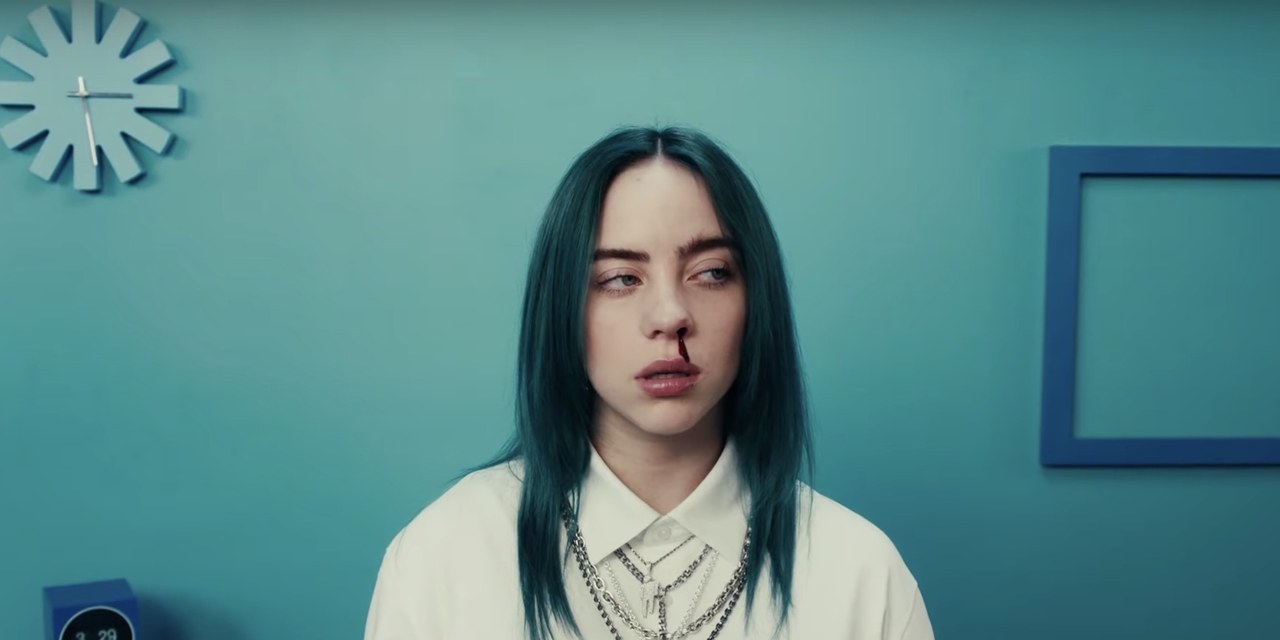
Then there’s her image. Eilish has created a brand largely through Instagram. Snaps of her face and of her wearing baggy, androgynous clothes: deadpan eyes, little to no makeup, nose bleeding in videos, messy blue hair. The stuff of nightmares for parents. You couldn’t get further from pop princess if you tried.
Eilish’s musical creativity and genius comes out in full force on tracks like ‘ilomilo’ which deals with Eilish’s fear of losing another friend. Last year in June, XXXTentacion (a 20 year old American rapper), died in a shooting. Death and the fear of it underpin the album, highlighting Eilish’s unease at the world around her. The darkness that overcame Spears in her late career is laid bare for all to see here, finally getting a voice and, in turn, redefining what pop music can and cannot say.
Confusion, fear, death, loss, hell, hills burning in California… pop isn’t what it used to be. But then again, neither is the world in which it inhabits.
 The female perspective