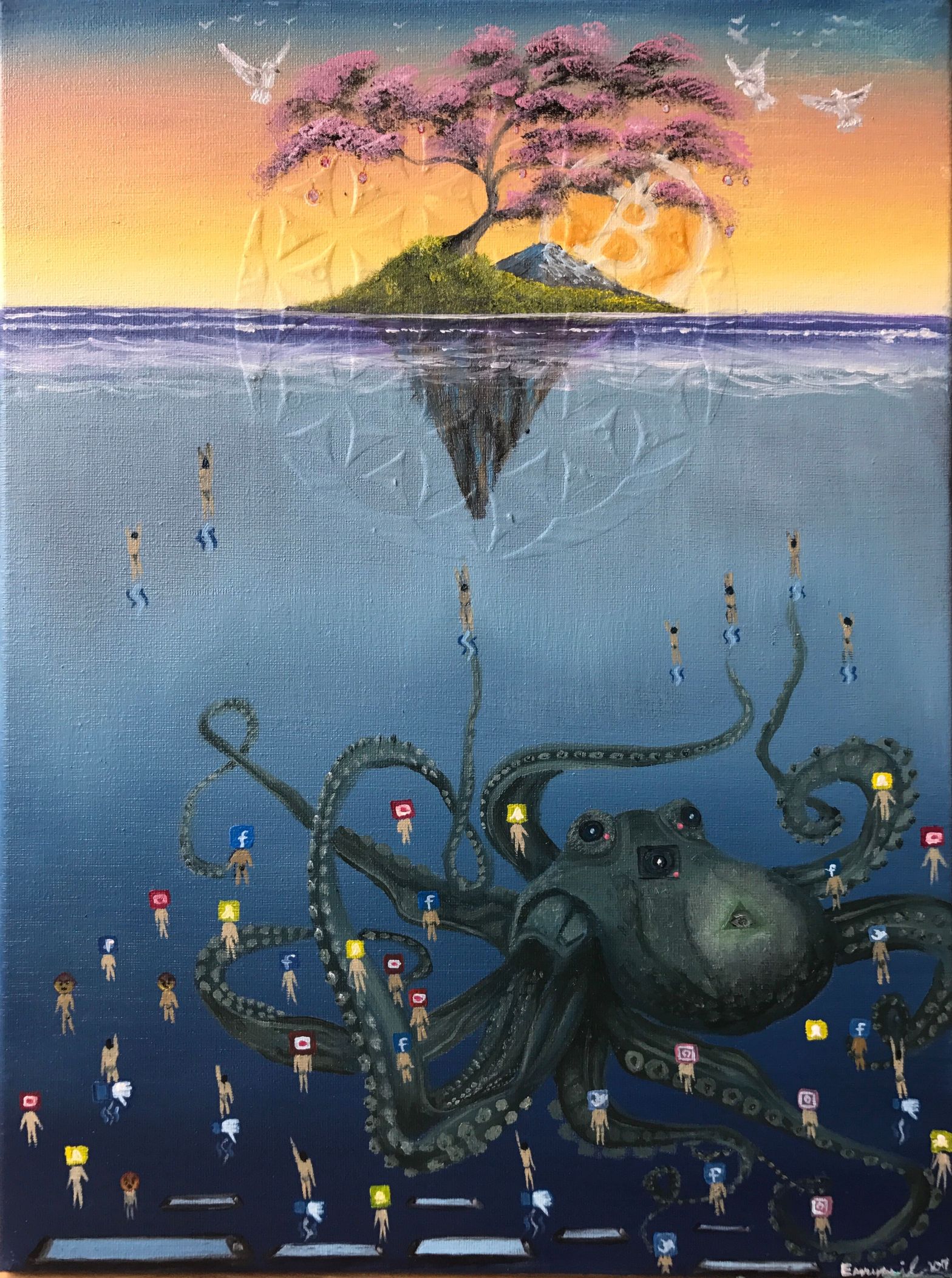
My job as a copywriter consists of making language simple. Long words have to be cut down into shorter ones. Anything vague or “not to the point” needs to be condensed and pulverised into something that resembles good writing, but is actually a regurgitation of another agency’s ideas. Every word is for the purpose of an unknown reader’s consumption. Assume they have the mental age of 7. Every phrase should be clear and concise, with no words that are unnecessary. No filler. People need to know what we are saying at a glance; reading is too time consuming. Some might just look at the picture. Language is in service of a product to be consumed, diced and presented as a canopé. A lot of the time I feel like a bizarre chef, slicing and chopping sentences, reassembling them to look slightly different to what they were. It all reads like mush.
My creative manager tells me he wants my writing to be less like a story. It is too fanciful, too fluffy, too difficult to understand. For the public to be attracted to our company and to want to use our design services, my writing should be as dumbed down as possible. Two paragraphs. Three at most. A short introductory paragraph. Some descriptive words that “sum up our process and highlight our expertise”. I try to stay focussed. When I open the word document I get distracted, or depressed, I can’t tell which. He tells me its a great skill to be able to write good copy. Good copy is a bunch of words that say everything quickly, a sickly layer of icing on the top of a hollow cake. No fluff! Little captions sit at the bottom of pages and direct users to another page of short sentences. These are calls to action. 10 words maximum. Efficiency is key. I spend a lot of time on thesaurus.com looking for other ways to say “convey” and “efficient”. The words are gobbled up like fast food, then spat out within a matter of minutes. A puddle of concise language in a neat pile on the floor.
My creative manager sends me examples of good copy. I read them all, my notepad open, ready to jot down examples of greatness. His favourite example is a smoothie ad full of cute little jokes. “Eat drink and be healthy”. The running theme is a play on words. Clever ads. He likes the wittiness of the adverts, he says. I should try and capture this in my writing. Writing should be relatable and fun, not hard to access like mine is. There is no room for deeper meaning. Good advertising is washed down like a sweet smoothie; no bits of course. The public might choke.
One day I come in looking bedraggled; I’d barely slept the night before. I already feel exhausted on my commute to the office. I sit down and log onto my computer, my mind detached from my hand movements. At 1015 my creative manager asks to speak to me into a meeting room. I feel a twist of guilt and salvation. Maybe he’s going to fire me. Maybe I should pack up my things. I picture calling my mum after work outside the office. I wonder how I could spin this to my friends to make it seem positive. “Well, it was never a forever job, you know, I just took it for the money and the experience, I was never going to stay there forever… it’ll look good on my CV though. I’ve already started applying to other things, there’s this cool smoothie company that does amazing copy… maybe il apply there…” .
My creative manager sits with a cafetière of coffee and two mugs on the white table. The hallmark of his professionalism. I sit down next to him. He smiles. “How you doing?” I smile. A clownish grin that hurts my muscles. “Yea I’m good…” I reply. He nods. “How’re you finding the role?”. I don’t know what to say. I think of some acceptable answers, and settle on “yea it’s fine… it’s quite challenging just now. I’m finding it hard to write”.
I’m not finding it hard to write. Every night I go home and write strange, scrawled stories about my ex boyfriend and his new girlfriend. I open his Facebook and masturbate at about 9pm, then fall asleep with my laptop open. When I wake up I read the stories, and sometimes I delete them.
My creative manager smiles at me again. I wish he’d stop looking at me. “I know how it feels to have creative block” he says. He looks like he wants to look like he’s deep in thought. “Sometimes creativity is difficult. Some advice- don’t think about what you’re writing. That should work better. We want to be as productive as possible, we need all hands on deck, your role is to promote the company, I can send you over some more adverts.” I smile and we get up to leave the room.
I sit back down at my desk, sinking into the leather chair. I open the word document I minimised. I delete the two sentences I wrote. I start again. I let my mind go totally blank. I write a paragraph: “Branding is everything. When a brand works well, you don’t need a logo. Good branding stands the test of time”. I send it over to my creative manager. He emails back a few minutes later- “much better. Keep going like this.”
I feel a giddy sense of validation. I write two more paragraphs. He tells me to break one of them into two paragraphs; it feels too heavy in content. Later I upload them to the website with a picture.
I open the advertisements he sent me again, searching for some hidden meaning, something I’m missing. When I don’t see it, I pack up my things and sling my bag over my shoulder. He doesn’t look up from his computer, so I leave. I walk to the top of the street to get my bus, which takes me 15 minutes. I’m tired. I scroll Facebook and open my ex’s page. Nothing new since yesterday. Over the course of the journey I listen to my playlist called “deja vu”. I go through my Spotify playlists and rename them, feeling a wave of creativity washing around my brain, like a cold liquor sloshing away the desert grains of advertising slogans. I wonder what my creative manager would think of these abstract names. I start to feel more normal. My stomach unknots, my legs uncross, and I’ll feel this sense of calm until 9am the next morning.
 The female perspective